
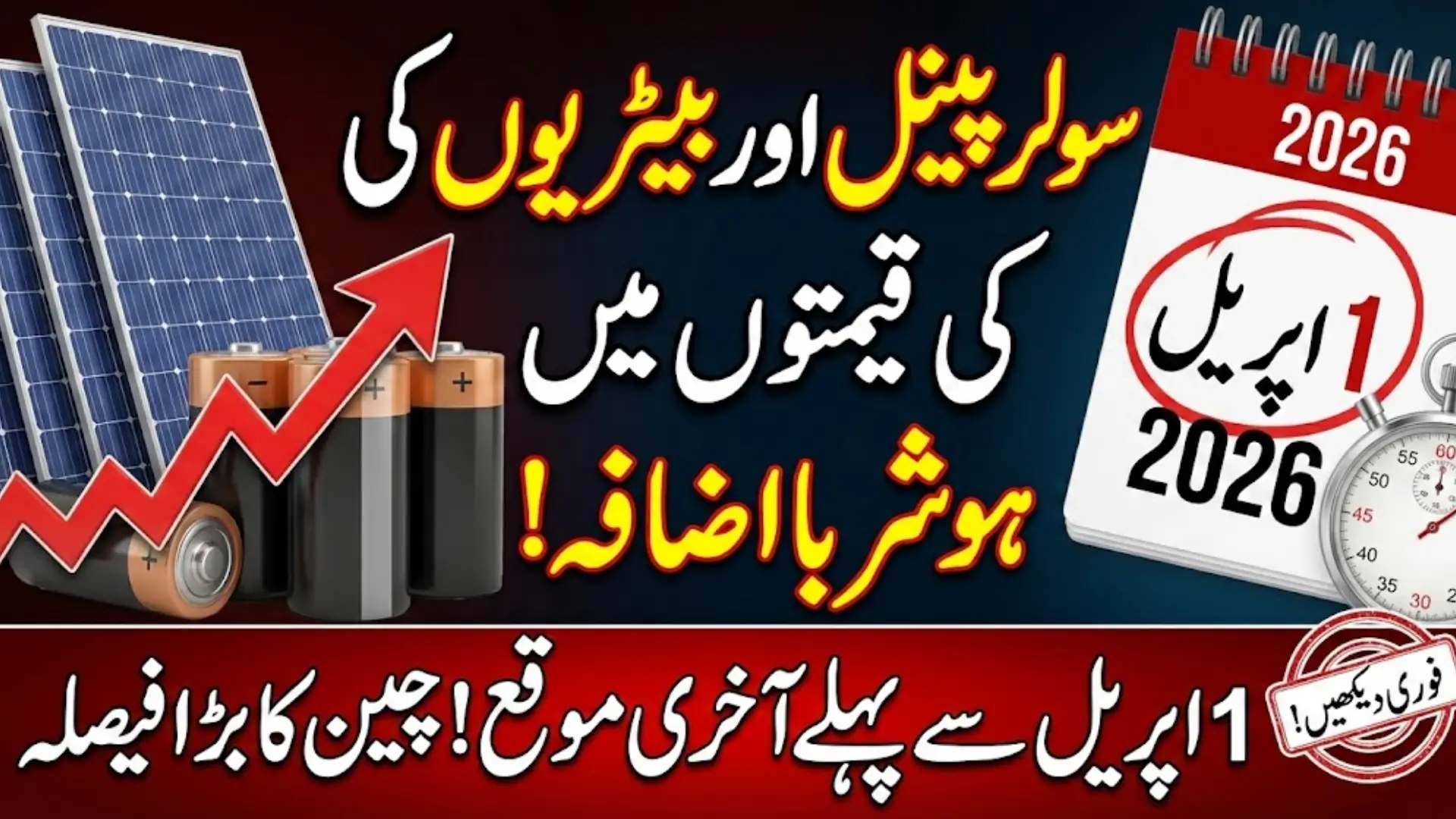
Solar Panel and Battery Prices Increase
Solar Panel and Battery Prices global solar industry is facing a major shift in 2026 that will impact buyers and installers worldwide. For years, falling solar panel and battery prices have encouraged households, businesses, and industries to switch to renewable energy. However, a recent policy change by China, the world’s largest producer of solar equipment, is set to disrupt the market and push prices higher.
This shift is not just a minor adjustment; it marks a structural change in the global solar supply chain. Analysts warn that countries heavily dependent on imported photovoltaic (PV) products, like Pakistan, could see a noticeable rise in costs. With solar adoption accelerating locally due to high electricity tariffs and frequent load-shedding, any increase in prices will directly affect consumers and developers.
Experts say the timing of this development is significant. Buyers and project planners in Pakistan need to understand these changes to make informed decisions. Those who act early may benefit, while late adopters could face higher expenses.
You Can Also Read: Today Weather Latest Update 2026 In Pakistan Rain and Snow
China Ends Export Tax Support for Solar Products
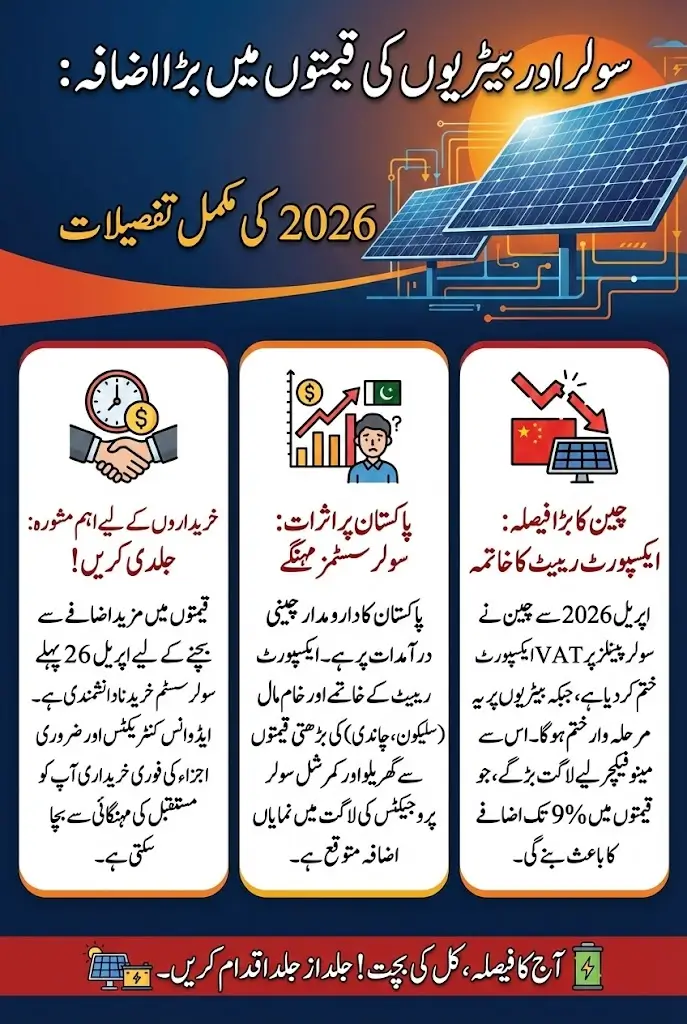
In January 2026, China’s Ministry of Finance and State Taxation Administration announced the withdrawal of value-added tax (VAT) export rebates on photovoltaic products. The change is effective from April 1, 2026. Export rebates on solar panels will end completely, while rebates for batteries will be phased out gradually and removed by 2027.
Export rebates previously allowed Chinese manufacturers to keep their products competitively priced for international buyers. With this support gone, the cost of solar panels and batteries is expected to rise sharply. Industry insiders describe this as a structural cost shift rather than a minor adjustment, meaning higher prices are unavoidable for countries importing solar equipment from China.
For Pakistan, which imports the majority of its PV modules and batteries from China, this move could have a direct impact on project costs. Developers, installers, and consumers are likely to experience a noticeable increase in system prices starting April 2026.
You Can Also Read: Ramadan Relief Approved: CM Maryam Nawaz
Why This Policy Change Will Drive Prices Up
The removal of export rebates increases production costs for manufacturers. According to Shanghai Metals Market, the policy could reduce export profits for a standard 210R photovoltaic module by up to 51 yuan per unit.
Key reasons why prices will rise:
- Manufacturers can no longer offset costs through VAT rebates
- Exporters are likely to pass the extra costs to buyers
- Combined with rising raw material prices, the effect on final prices will be significant
Industry analysts estimate that module prices could increase by up to 9 percent, while battery costs will gradually follow. For Pakistan, this means solar systems will no longer be available at pre-April 2026 rates, making early procurement critical for cost-sensitive consumers.
You Can Also Read: PTA 5G Spectrum Auction 2026: 80% of Mobile Phones in Pakistan
Immediate Impact on International Buyers
The policy change has prompted global buyers to accelerate their orders to benefit from existing rebates before April 1. Shipping volumes are expected to spike in the short term, followed by slower demand once prices adjust.
Observations from industry insiders indicate:
- Exporters are renegotiating contracts to reflect higher costs
- Large buyers are fast-tracking procurement to avoid price increases
- Short-term supply may increase, but longer-term prices will remain elevated
Pakistani solar developers who rely on imported modules may need to reconsider project timelines to minimize exposure to higher costs.
Rising Raw Material Costs Intensify the Problem
The policy-driven price increases are compounded by rising costs of essential raw materials. Polysilicon, used in PV cells, has surged nearly 10 percent month-on-month. Similarly, silver, a key component for cell conductivity, has reached record levels.
These factors contribute to the overall increase in module and battery prices. In combination with the removal of export rebates, global solar equipment prices are poised for a noticeable upward trend.
- Polysilicon and silver price spikes
- Rising freight and shipping costs
- Overall pressure on module and battery production costs
For Pakistan, this translates into higher landed costs for solar systems, affecting both residential and commercial installations.
You Can Also Read: Samsung Galaxy A57 Design Reveal Expected Launch
Solar Panel Cost Increase: What Numbers Show
Industry estimates suggest module prices could rise up to 9 percent after April 2026. Exporters are already factoring in losses from the removal of VAT rebates, making price pass-through to buyers inevitable.
Estimated Impact on Solar Prices
| Factor | Effect on Cost |
|---|---|
| Removal of 9% export VAT rebate | Up to 9% increase in panel price |
| Exporter profit loss | ~51 yuan per module |
| Raw material inflation | Additional 5–8% price impact |
This table illustrates how multiple factors are combining to increase the cost of solar equipment in international markets.
You Can Also Read:
Battery Prices Also Set to Increase
While panels are immediately affected, battery products will experience a gradual price rise until rebates are fully removed in 2027. Energy storage systems, critical for off-grid and backup solar setups, are therefore expected to become more expensive over time.
For Pakistanis planning to install solar with battery backups, this is a key consideration. Early purchases may help mitigate price increases, but delays could result in significantly higher system costs.
Pakistan’s Dependence on Imported Solar Equipment
Pakistan imports most of its solar panels and batteries from China, making it highly sensitive to global market changes. Any price increase abroad translates directly into higher project costs locally.
- Rooftop solar systems for homes and businesses will become costlier
- Commercial solar projects will see tighter margins
- Agricultural solarization, including tube wells, will face higher upfront expenses
Developers are already adjusting quotations to reflect anticipated price increases, and end consumers are likely to feel the impact in 2026.
What This Means for Pakistan’s Solar Adoption
Despite higher prices, solar energy in Pakistan remains cost-competitive compared to conventional electricity. However, sustained price increases could slow the adoption rate, especially among price-sensitive consumers.
- Middle-class households may delay installations
- Small businesses could postpone solar investments
- Large-scale projects may pass higher costs onto end users
Solar remains a necessary solution to high electricity tariffs and frequent load-shedding, but timing is now crucial. Early procurement could save money before prices rise further.
Short-Term Opportunities Before Prices Rise
Industry experts suggest that buyers act quickly before the April 2026 deadline. Procuring equipment early can help avoid immediate price increases and provide a buffer against future inflation.
Tips for Pakistani buyers:
- Secure panels and batteries now to lock in costs
- Prioritize essential system components first
- Consider advance contracts to reduce exposure to price fluctuations
Acting early can make a significant difference for households and businesses planning solar systems in the coming months.
Long-Term Outlook for Solar Energy in Pakistan
Even with rising costs, solar energy is expected to remain a viable option in Pakistan. Conventional electricity continues to increase in price, and load-shedding remains a persistent problem.
However, buyers should anticipate a more mature and price-sensitive market. Installers may focus on efficiency and long-term cost savings rather than short-term affordability. Strategic planning and timely procurement will become essential for anyone entering the solar sector.
Final Takeaway
The year 2026 marks a structural shift in solar pricing. China’s export rebate removal, combined with rising raw material costs, has created a new reality for solar buyers in Pakistan.
- Panel prices may rise up to 9% after April
- Battery systems will gradually become more expensive
- Early procurement and strategic planning are now essential
Pakistanis planning solar installations should act promptly to reduce exposure to price increases and make the most of the remaining opportunities before April 2026.