

Zewar Taleem Program Status Check
Zewar Taleem Program Status Check is one of the most practical education support initiatives launched in Punjab for girls belonging to poor and deserving families. During my work and observations across different districts of Punjab, I have seen many families who want to educate their daughters but simply cannot afford school-related expenses. This program was designed exactly for such households, where financial pressure forces girls to drop out after primary education. The Punjab government introduced this initiative to ensure that poverty does not become a barrier to education.
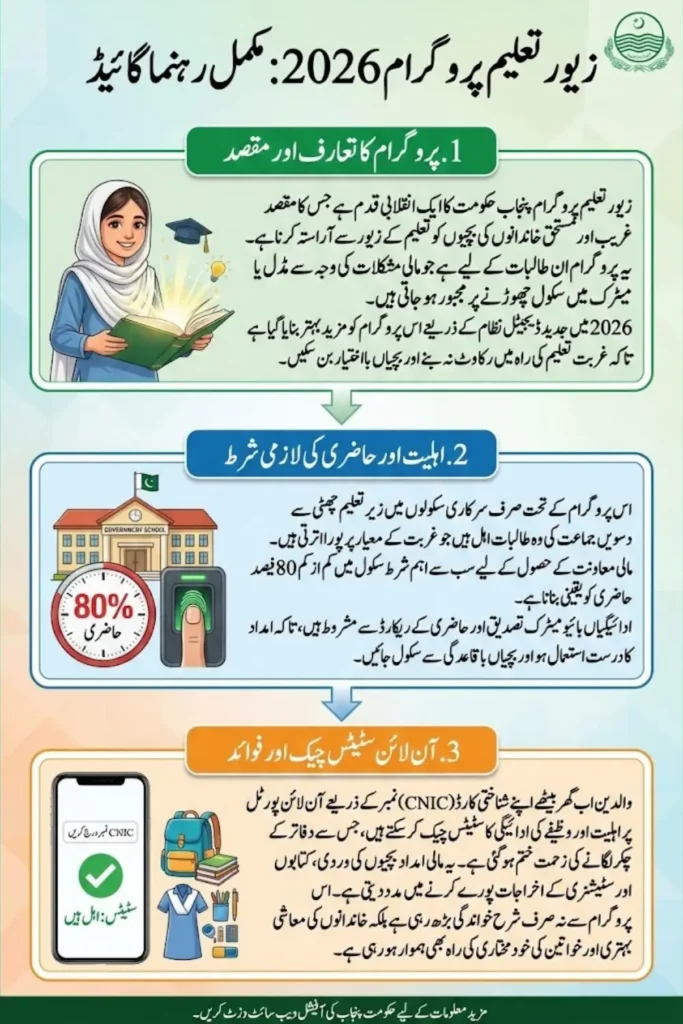
In 2026, the Zewar Taleem Program continues with improved digital systems, better monitoring, and easier access for parents. The most important improvement is the CNIC-based online status check system, which allows families to verify eligibility and payment details without running from one office to another. This guide explains everything in simple language so that even an ordinary Pakistani citizen can understand and benefit from it.
Purpose and Vision Behind Zewar Taleem Program
The vision behind the Zewar Taleem Program is long-term social change through education. The Punjab government realized that unless girls remain in school, issues like poverty, early marriages, and unemployment will continue. This program links financial support directly with school attendance so that education remains the main focus, not just cash assistance.
The government aims to achieve multiple goals through this initiative:
- Increase enrollment of girls in middle and secondary classes
- Reduce dropout rates after primary education
- Support families facing financial hardship
- Promote gender equality through education
By attaching conditions such as attendance and school verification, the program ensures that public money is used effectively for educational development.
You Can Also Read: PM Youth Loan Scheme 2026 Get 5 To 75 Lakh Without
Role of Punjab Social Protection Authority in Implementation
Punjab Social Protection Authority (PSPA) is the backbone of the Zewar Taleem Program. PSPA is responsible for identifying eligible beneficiaries, managing data, releasing payments, and addressing complaints. This authority already runs several social welfare programs, and its experience has helped bring transparency and discipline to the Zewar Taleem initiative.
From what I have observed, PSPA’s involvement has reduced corruption and favoritism. The use of service cards, biometric verification, and digital records ensures that assistance reaches only deserving families. Parents now have more confidence because they can track their status using official systems instead of relying on agents or middlemen.
You Can Also Read: PM Electric Loaders Rickshaws Scheme For Talented Jobless
Who Can Apply for Zewar Taleem Program
The Zewar Taleem Program is not open for everyone; it is strictly targeted at a specific group to ensure fairness and impact. Only girls from poor families studying in government schools are eligible. This clear targeting helps the government focus resources where they are most needed.
Eligibility highlights include:
- Only female students are eligible
- Students must be enrolled in government schools
- Classes covered range from 6th to Matric
- Families must fall under poverty criteria
This eligibility structure ensures that the program supports those who genuinely need help to continue education.
You Can Also Read: Apply Now Free 3 Marla Plot in AZAG Scheme + 15 Lakh Home
Attendance Requirement and Its Importance
Attendance is the most critical condition under the Zewar Taleem Program. The government has made it clear that financial assistance will only continue if the student maintains regular school attendance. This condition has changed the behavior of many families, especially in rural areas, where girls’ education was previously not taken seriously.
Key attendance-related points include:
- Minimum 80% attendance is mandatory
- School records are checked regularly
- Payments depend on attendance verification
If attendance drops below the required level, payments may be delayed or stopped until the issue is resolved. This encourages parents to ensure their daughters attend school regularly.
Districts Covered Under Zewar Taleem Program
The program was initially launched in districts with low literacy rates, particularly among girls. These areas were identified through education data and poverty surveys. The focus on underdeveloped districts ensures that the program reaches the most neglected communities.
The following districts are included in the Zewar Taleem Program:
| Covered Districts in Punjab |
|---|
| Bahawalnagar |
| Bahawalpur |
| Bhakkar |
| Chiniot |
| DG Khan |
| Jhang |
| Kasur |
| Khanewal |
| Layyah |
| Lodhran |
| Muzaffargarh |
| Okara |
| Pakpattan |
| Rajanpur |
| Rahim Yar Khan |
| Vehari |
These districts represent areas where girls’ education needs the strongest support.
You Can Also Read: BISP Announces Fresh Vault Account District List:
Financial Assistance and Payment Structure
The financial assistance provided under the Zewar Taleem Program is designed to support education-related expenses. This includes uniforms, books, stationery, and other basic school needs. The cash support is conditional, meaning it is released only after meeting attendance and verification requirements.
Important features of the payment system are:
- Cash assistance linked with school attendance
- Payments released after biometric verification
- Focus on supporting education expenses
This structure ensures that the money is used for its intended purpose and contributes directly to educational continuity.
CNIC-Based Online Status Check System
One of the most helpful features introduced in recent years is the CNIC-based online status check system. Parents and guardians can now check whether their child is eligible and whether payments have been released by using their CNIC number. This system has significantly reduced the need for physical visits to offices.
The online system verifies:
- CNIC of parent or guardian
- Student enrollment details
- Attendance and school records
This digital approach saves time, reduces confusion, and provides transparency to beneficiaries.
How to Check Zewar Taleem Program Status Online
Checking the Zewar Taleem Program status online is a simple process that can be completed in a few minutes. Even people with basic mobile or computer knowledge can use this system easily.
Steps to check status online include:
- Visit the official PSPA or Zewar Taleem portal
- Enter the CNIC number of the parent or guardian
- Fill in the verification code shown on screen
- Click on the “Check Status” option
After submitting the information, the system will display eligibility and payment details clearly.
You Can Also Read: E Taxi Scheme Check Name In Balloting List
Biometric Verification Process Explained
Biometric verification is a mandatory step before releasing payments. This process ensures that the financial assistance reaches the correct family and prevents misuse of public funds. Parents or guardians are required to complete biometric verification at designated centers.
Biometric verification includes:
- Thumb impression of parent or guardian
- CNIC verification through NADRA
- Confirmation of student enrollment
If biometric verification fails, families should update their records to avoid payment delays.
Common Reasons for Rejection or Payment Delay
Many families worry when payments are delayed, but in most cases, the reasons are simple and fixable. Understanding these reasons can help families avoid unnecessary problems.
Common reasons include:
- Attendance below the required 80%
- Student enrolled in a private school
- CNIC or biometric data mismatch
- Incomplete school records
Correcting these issues early can help restore payments smoothly.
Impact of Zewar Taleem Program on Girls’ Education
Educating girls has a powerful impact on families and society. From my experience, families who keep their daughters in school through programs like Zewar Taleem see long-term benefits. Educated girls grow into confident women who contribute positively to society.
Major benefits include:
- Reduced poverty and dependency
- Improved family health and awareness
- Stronger and educated future generations
This is why the Zewar Taleem Program is considered a vital investment in Pakistan’s future.
You Can Also Read: BISP 2026 Payment Alert: Newly Registered Women
Guidance for Parents and Guardians
Parents play a crucial role in ensuring the success of this program. They must focus on maintaining attendance, keeping records updated, and using only official channels for information. Paying attention to these details helps avoid problems and ensures smooth payment flow.
The Zewar Taleem Program is not just financial help; it is an opportunity to secure a better future for daughters. If used responsibly, it can change the direction of entire families through education.