

PTA 5G Spectrum Auction 2026 Starts
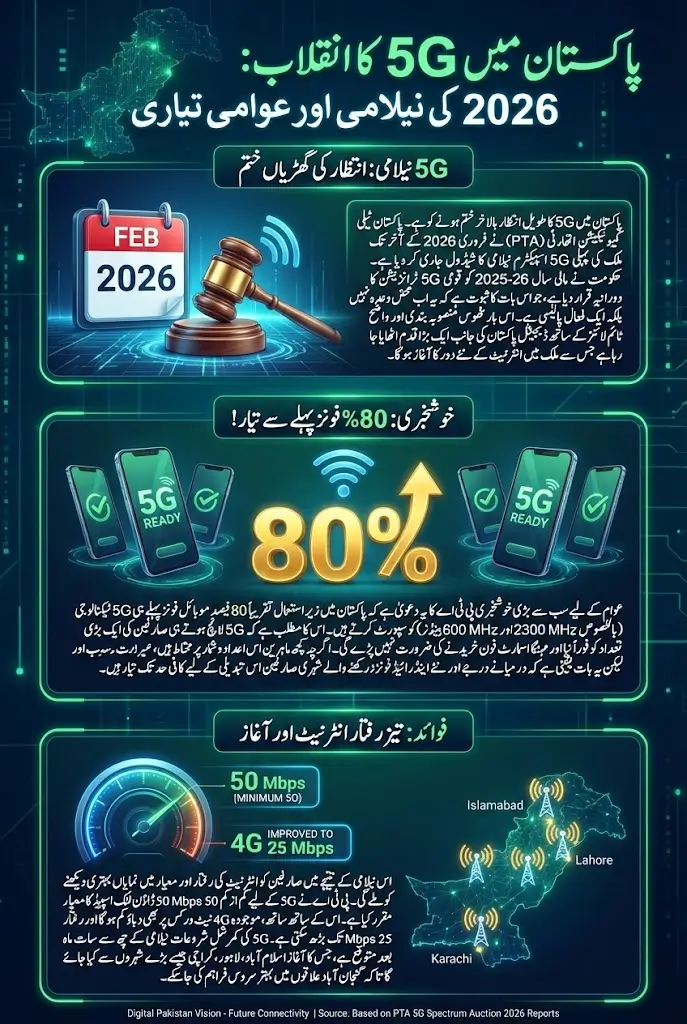
Pakistan is finally moving from discussion to action when it comes to 5G. After years of delays and speculation, the Pakistan Telecommunication Authority (PTA) is preparing to conduct the country’s first-ever 5G spectrum auction by the end of February 2026. According to officials familiar with the process, a major portion of mobile users may already be ready for this shift, as nearly 80 percent of mobile phones in Pakistan are said to support the key frequency bands required for 5G.
From what I have observed while covering telecom developments in Pakistan, this announcement has created cautious optimism. People are hopeful but also asking practical questions: Will speeds really improve? Will existing phones work? And will 5G make daily internet usage better, or just add another expensive label?
Pakistan’s Entry into the 5G Era
The federal government has officially declared the fiscal year 2025–26 as Pakistan’s national transition period for 5G. This declaration is important because it signals that 5G is no longer a future promise but an active policy objective. PTA’s recent actions show that preparations are being taken seriously, with timelines, rules, and obligations clearly defined.
In earlier years, announcements around 5G were often followed by silence. This time, however, the release of official documents and auction frameworks suggests a different approach. The regulator appears focused not only on launching 5G but also on improving the overall quality of mobile services in the country.
Growing 5G Readiness Among Mobile Users
PTA sources claim that almost 80 percent of mobile phones currently in use across Pakistan support the 2300 MHz and 2600 MHz bands, which are essential for mid-band 5G services. If this figure holds true, it means a large number of users will not need to replace their smartphones immediately after 5G launches.
However, industry insiders have expressed doubts about this number, especially when considering rural areas and low-cost devices. Based on market trends, it is more likely that urban users with mid-range and newer smartphones are better prepared, while many others will still rely on improved 4G networks.
What mobile users should realistically expect:
- Newer Android phones are more likely to be 5G-ready
- Older smartphones will continue to work on enhanced 4G
- Immediate phone upgrades will not be necessary for everyone
Understanding the Role of Mid-Band Frequencies
Mid-band spectrum plays a central role in Pakistan’s 5G strategy. Frequencies like 2300 MHz and 2600 MHz are globally recognized for offering a balance between coverage and speed. These bands allow networks to carry more data without compromising stability, which is crucial in densely populated cities.
In practical terms, mid-band spectrum helps reduce congestion on mobile networks. Anyone who has experienced slow internet during peak hours in cities like Lahore or Karachi understands why this matters. With more spectrum available, operators can serve more users simultaneously.
Key benefits of mid-band spectrum include:
- Better performance in crowded urban areas
- Fewer dropped connections during busy hours
- Smoother transition from 4G to 5G
Official Timeline for the 5G Spectrum Auction
According to PTA officials, the 5G spectrum auction is expected to take place by the end of February 2026. The timeline was set after the Information Memorandum was issued on January 9, 2026, giving potential bidders around 45 days to complete documentation and meet eligibility requirements.
This structured schedule is significant because telecom auctions in Pakistan have often been delayed in the past. A clear timeline increases confidence among investors and operators, which is essential for long-term infrastructure development.
If the process remains on track, commercial 5G services could begin rolling out toward the second half of 2026.
Information Memorandum and Auction Framework
The Information Memorandum issued by PTA outlines the complete auction framework. It explains the rules, available spectrum blocks, and obligations that winning operators must fulfill. This document also defines quality benchmarks, ensuring that services meet minimum performance standards.
From a regulatory standpoint, the IM helps prevent confusion and disputes. Operators know in advance what they are bidding for and what responsibilities come with it. This transparency is critical for a smooth auction process and effective service rollout.
Main areas covered in the Information Memorandum:
- Auction rules and bidding process
- Eligibility and documentation requirements
- Quality of Service obligations
- Network rollout and infrastructure targets
Spectrum Bands Included in the Auction
The upcoming auction will offer approximately 597.2 MHz of spectrum below 6 GHz. This spectrum includes multiple frequency bands designed to support both existing 4G services and future 5G deployments.
Planned Spectrum Allocation Overview
| Frequency Band | Primary Purpose |
|---|---|
| 700 MHz | Wider coverage and better indoor signals |
| 1800 MHz | Strengthening existing 4G networks |
| 2100 MHz | Capacity improvement for mobile data |
| 2300 MHz | Balanced coverage and 5G performance |
| 2600 MHz | High-speed data in urban areas |
| 3500 MHz | Core 5G services and low latency |
This mix shows that PTA is aiming for a practical and phased upgrade rather than a sudden shift.
Impact on Existing 4G Network Performance
One of the most overlooked aspects of the 5G auction is its impact on 4G services. PTA sources indicate that after the release of additional spectrum, average 4G speeds could increase from around 4 Mbps to 20–25 Mbps in urban areas.
For most users, this improvement will be immediately noticeable. Faster loading times, smoother video streaming, and more reliable calls are benefits that will reach users even before full 5G rollout.
Expected improvements for 4G users include:
- Better performance during peak hours
- Improved video and voice call quality
- Reduced network congestion
Expected Improvements in Mobile Internet Speeds
For 5G services, PTA has set a minimum downlink speed of 50 Mbps as part of mandatory Quality of Service requirements. This ensures that 5G delivers a meaningful upgrade rather than just a marketing label.
In real-world usage, this means faster downloads, more stable video calls, and better support for online services such as cloud applications and digital payments. As networks mature, speeds are expected to improve further.
Quality Standards Set for 5G Services
Unlike previous generations, 5G services in Pakistan will be launched with clearly defined quality benchmarks. PTA will monitor operators to ensure compliance with speed, availability, and reliability standards.
This regulatory oversight is important because it protects consumers from poor service quality. It also pushes operators to invest properly in infrastructure rather than relying solely on spectrum acquisition.
How Different Frequency Bands Will Be Used
Each frequency band included in the auction serves a specific purpose. PTA plans to use them strategically to balance coverage, speed, and capacity.
- 2300 MHz will support stable coverage in urban centers
- 2600 MHz will handle heavy data traffic
- 3500 MHz will deliver high-speed 5G with low latency
This layered approach allows networks to perform efficiently under different usage conditions.
Initial Cities Selected for 5G Rollout
Commercial 5G rollout is expected to begin six to seven months after the auction. Initial coverage will focus on major cities where demand is highest and infrastructure already exists.
Cities expected to receive early 5G coverage include Islamabad, Lahore, Karachi, Peshawar, and Quetta. This phased rollout allows operators to test and optimize networks before expanding nationwide.
Strengthening Network Infrastructure Through Fiber Expansion
A key condition of the auction is the expansion of fiber-to-the-site infrastructure from the current 20 percent to 60 percent. Fiber connectivity is essential for both advanced 4G and 5G services.
This requirement will improve network reliability, reduce latency, and support long-term digital growth across Pakistan. Without strong fiber infrastructure, even the best spectrum cannot deliver consistent performance.
Industry Concerns and Conflicting Claims
While PTA’s outlook is optimistic, some telecom industry sources have questioned the claim that 80 percent of devices are already compatible with 5G bands. According to them, the actual number may be lower, especially outside major urban centers.
These concerns highlight the need for realistic expectations. However, even a lower compatibility rate would still place Pakistan in a better position than during earlier technology transitions.
What the 5G Auction Means for Consumers
For ordinary Pakistanis, the 5G spectrum auction is about more than just speed. It represents improved reliability, better access to digital services, and a foundation for future technologies.
Consumers can expect:
- Faster and more stable mobile internet
- Improved service quality in congested areas
- Gradual and manageable rollout
Pakistan’s Long-Term Digital Connectivity Vision
The 5G spectrum auction marks a critical step in Pakistan’s digital journey. If implemented effectively, it can support economic growth, digital inclusion, and improved public services.
From my experience observing the telecom sector, this moment feels different. The planning appears more mature, the timelines clearer, and the focus broader. The coming year will show whether Pakistan can turn this opportunity into lasting progress for its people.