
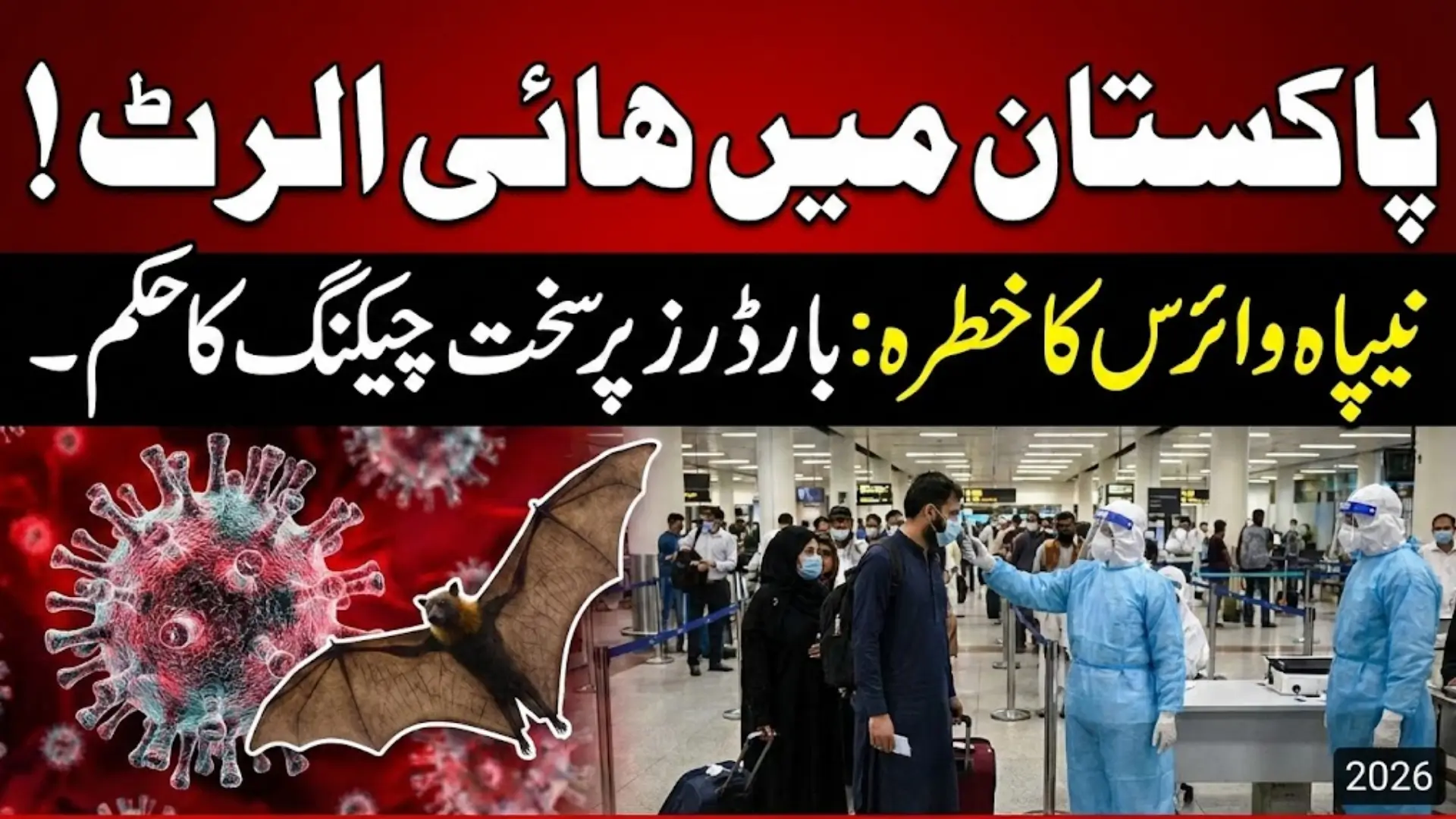
Nipah Virus Outbreak
Nipah Virus Outbreak Pakistan In January 2026, health authorities across South Asia entered a state of high alert following renewed reports of the Nipah virus. Although Pakistan has not reported any confirmed human case so far, developments in neighbouring India, particularly in West Bengal, prompted serious concern among public health officials. In today’s interconnected world, diseases do not stop at borders, and Pakistan’s health system has learned from past regional and global outbreaks that early preventive action is always safer than late reaction.

As a journalist covering health and governance, it is clear that Pakistan’s response this time is shaped by experience. From COVID-19 to dengue surges, authorities now understand that timely screening, surveillance, and communication can significantly reduce risk. The Nipah virus alert is being treated as a precautionary challenge rather than a crisis, which reflects a more mature and responsible approach to public health management.
You Can Also Read: PSER Online Registration 2026 For Ramzan Relief Package
What Triggered Pakistan’s Immediate Action
Pakistan’s decision was influenced by alerts issued through international and regional disease surveillance systems, including the World Health Organisation (WHO). The confirmation of Nipah virus cases in India in late 2025 raised red flags for all neighbouring countries, especially those with frequent cross-border travel.
Health officials believe that waiting for local cases to appear would be a serious mistake. Instead, Pakistan chose to act early by strengthening border controls, ensuring that any potential case is identified before it can enter communities and cause harm.
Understanding Nipah Virus in Simple Terms
Nipah virus is a dangerous infection that mainly spreads from animals to humans. Fruit bats are the natural carriers of the virus, and animals like pigs can also become infected and pass it on. Humans can catch Nipah either by direct contact with infected animals or through close contact with another infected person.
What worries doctors the most is that Nipah can affect the brain, leading to swelling, confusion, seizures, and even coma. In many cases, early symptoms look like common illnesses, which makes public awareness and screening extremely important.
You Can Also Read: Punjab Boards Announces Class 9 and 10 Exam Dates
Why Nipah Virus Is Classified as a Global Priority Threat
The WHO has classified Nipah virus as a priority pathogen because of its high fatality rate and outbreak potential. In some past outbreaks, more than half of the infected patients did not survive. This alone makes it one of the most feared viral diseases in the region.
Another major concern is the absence of an approved vaccine or specific cure. Treatment is mainly supportive, meaning doctors can only manage symptoms. This is why prevention, early detection, and isolation remain the most effective strategies.
You Can Also Read: 8171 SMS Service Check CNIC Status 2026
Government Decision to Strengthen Border Surveillance
The Ministry of National Health Services, through Border Health Services-Pakistan (BHS-P), ordered strict and enhanced health surveillance at all points of entry into the country. This decision applies immediately and covers every possible route through which travellers enter Pakistan.
Authorities have clearly stated that these instructions are mandatory. The aim is not to restrict travel unnecessarily, but to ensure that public health safety is not compromised under any circumstances.
You Can Also Read: Free Transport Likely as Punjab Talks With Ride-
Entry Points Now Under Enhanced Monitoring
All international airports, seaports, and land border crossings are now under enhanced monitoring. Whether someone is arriving by plane, ship, or road, they must undergo health screening before being allowed to enter the country.
This approach ensures uniform enforcement and avoids loopholes that could otherwise allow infected individuals to slip through unnoticed.
Mandatory Health Screening for All Travellers
Every individual entering Pakistan must undergo health screening by BHS-P officials. This applies to:
- Arriving passengers
- Transit passengers
- Airline and ship crew
- Drivers, helpers, and support staff
No one is allowed entry without official health clearance, regardless of nationality or travel status. Authorities acknowledge that this may cause minor delays, but stress that public safety comes first.
You Can Also Read: Punjab Parwaaz Card Eligibility Criteria Interest-Free Loans
Travel History Verification Rules
One of the most important steps introduced is the verification of travel history for the past 21 days. This helps identify travellers who may have passed through high-risk or affected areas.
Officials have made it clear that:
- False or incomplete declarations will be recorded
- Concealment of travel history can lead to legal action
- Travellers from high-risk regions will face extra scrutiny
You Can Also Read: Apna Khait Apna Rozgar Program Registration For Farmers
Thermal and Clinical Health Checks at Borders
Thermal screening is being used to detect fever, which is one of the earliest symptoms of Nipah virus infection. In addition to temperature checks, trained staff carry out clinical assessments to look for other warning signs.
Health teams are specifically watching for:
- Fever and severe headache
- Respiratory symptoms
- Neurological signs such as confusion or drowsiness
Handling of Suspected Nipah Virus Cases
If a traveller matches the suspected case definition, immediate isolation is enforced at the point of entry. Such individuals are not allowed to proceed further and are managed strictly under infection prevention and control protocols.
This step is crucial in preventing any chance of human-to-human transmission during travel or transit.
Hospital Referral and Emergency Response Plan
Suspected cases are promptly referred to designated isolation facilities or tertiary-care hospitals. Border authorities coordinate closely with provincial and district health departments to ensure smooth and safe transfer.
At the same time, the aircraft, vehicle, or vessel used by the suspected patient is thoroughly disinfected to eliminate any residual risk.
Infection Prevention Measures for Staff
Staff working at entry points are required to strictly follow infection prevention guidelines. This includes the mandatory use of personal protective equipment, regular hand hygiene, and proper sanitation of work areas.
Authorities have warned that any lapse in these measures will be treated as serious negligence.
Daily Reporting and National Coordination System
All points of entry must submit daily case or nil reports through the existing BHS-P system. These reports are shared with the National Command and Operation Centre and the National International Health Regulation Focal Point.
This system ensures real-time monitoring and allows authorities to respond quickly if the situation changes.
NIH Alert and Preparedness Strategy
The National Institute of Health (NIH) has also issued alerts to health departments and healthcare providers across the country. While Pakistan currently has no confirmed human case, the regional situation is being closely monitored.
The NIH has emphasised preparedness, laboratory readiness, and rapid response planning to handle any potential case efficiently.
Current Treatment and Medical Management Approach
There is currently no specific antiviral treatment or licensed vaccine for Nipah virus. Medical management focuses on supportive care, including managing fever, respiratory distress, and neurological complications.
Severely ill patients often require hospitalisation and intensive care support, including mechanical ventilation.
Advisory for Travellers and Returning Passengers
Travellers returning from affected areas are advised to remain vigilant for 21 days. Anyone developing symptoms during this period should self-isolate and seek immediate medical attention.
Informing healthcare providers about recent travel history can help doctors take timely and appropriate action.
Role of Provincial Health Departments
Provincial health authorities have been directed to designate at least one tertiary-care hospital for isolation and treatment. Public laboratories are also being instructed to strengthen safe sample handling and transportation procedures.
Rapid response teams are being kept on standby for investigation, contact tracing, and field response if required.
Expert Opinions on Risk Level in Pakistan
Health experts in Pakistan have stated that the overall risk of a Nipah outbreak remains low. The virus has specific transmission dynamics that limit widespread spread, especially in urban settings.
However, experts also stress that vigilance and preparedness must continue, as infectious diseases can change patterns unexpectedly.
Why Public Awareness Matters Without Panic
Public awareness helps people understand the disease and follow preventive measures calmly. Panic, on the other hand, leads to misinformation and unnecessary fear.
Authorities and health experts agree that informed citizens are the strongest defence against any potential outbreak.
Final Assessment of the Situation in 2026
Pakistan’s decision to enforce strict screening reflects a proactive and responsible public health strategy. While the current risk remains minimal, the country is taking no chances.
With continuous monitoring, coordination among authorities, and public cooperation, Pakistan aims to protect its population without creating unnecessary alarm.
Key Facts About Nipah Virus and Pakistan’s Response
| Category | Details |
|---|---|
| Natural Carrier | Fruit bats |
| Fatality Rate | 40% to 75% |
| Human Transmission | Close contact, bodily fluids |
| Vaccine Availability | None approved |
| Pakistan’s Action | Nationwide border screening |
| Screening Coverage | Airports, seaports, land borders |